
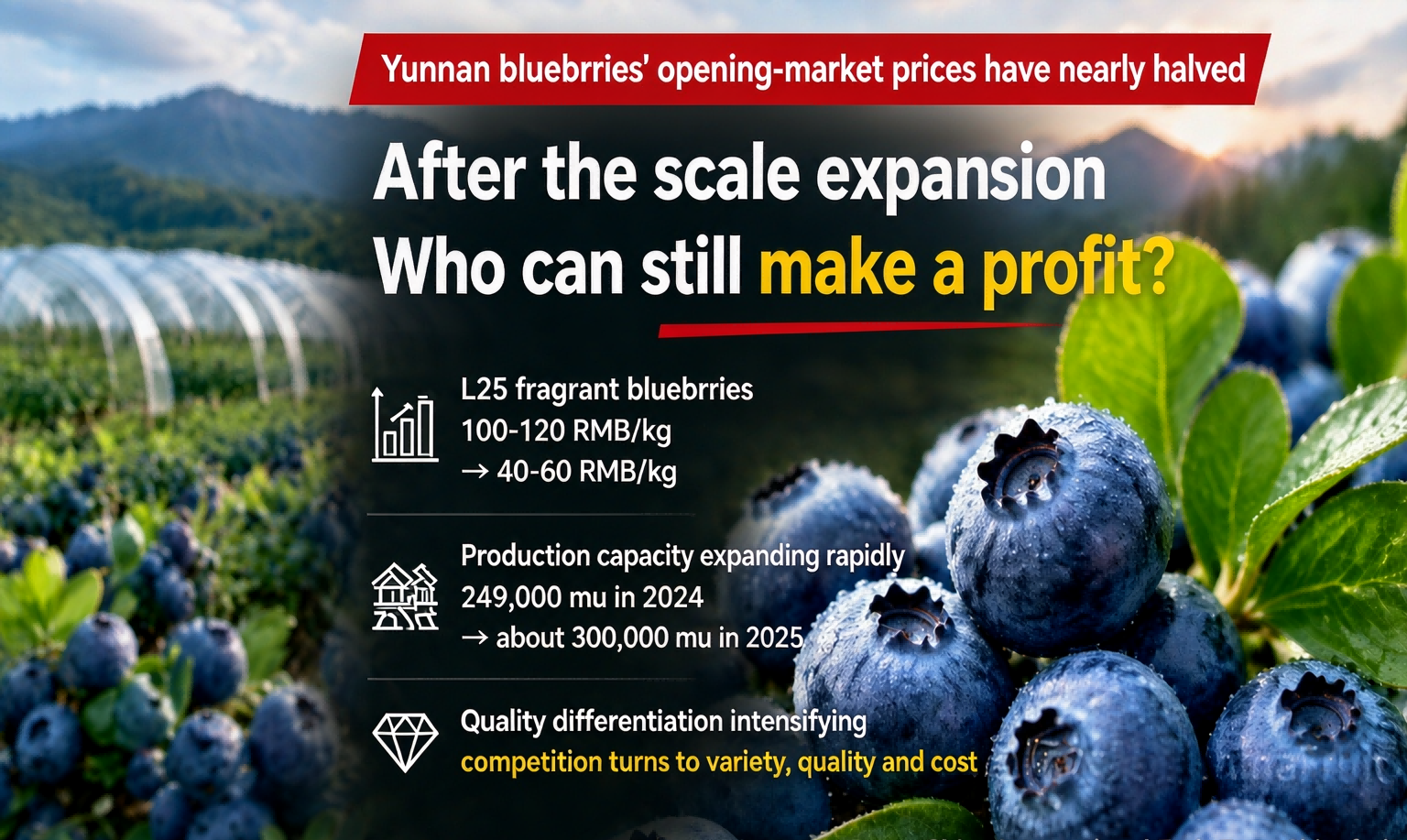
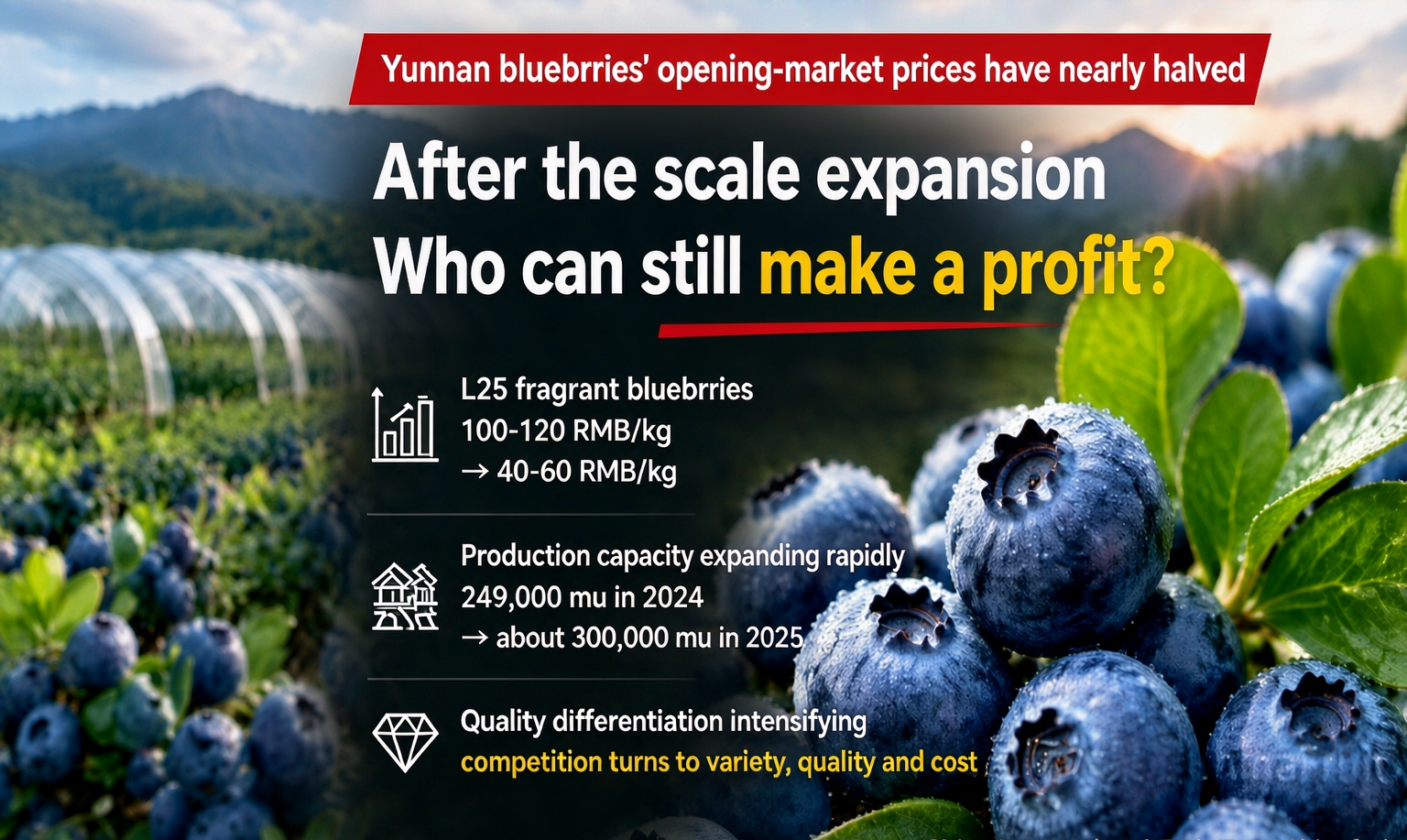
Blueberries were long positioned as a premium fruit in the market. Their relatively high prices stemmed both from the scarcity created by variety and seasonality, and from the recognition of their quality image across channels and consumers. In recent years, as domestic protected-cultivation area has expanded and supply capacity improved, this category has been undergoing a fairly pronounced price adjustment. Take Yunnan as an example: in the 2026 autumn-winter season, the farm-gate purchase price of L25 fragrant blueberries has fallen from 100–120 RMB/kg in the same period last year to 40–60 RMB/kg.
The current situation: substitution in "quantity" and substitution in "quality" are not yet in sync
From the perspective of industrial development, on one hand this change means domestically produced blueberries already possess strong supply capacity in terms of "quantity"; on the other hand, it also signals that the price advantage sustained by scale expansion alone is facing diminishing returns.
From the market's perspective, domestically produced blueberries have gradually built the ability to substitute for imported products in terms of supply scale, allowing consumers to obtain this category at more affordable prices — a direct reflection of industry progress. At the same time, however, a phenomenon worth noting is this: after prices fell, the quality differentiation between domestic and imported blueberries in consumers' minds has not yet been established.
In other words, substitution in "quantity" has progressed notably, while substitution in "quality" still needs to be strengthened. When the price anchor shifts downward across the board, and the category lacks clear, perceivable, and communicable quality standards, consumers' understanding of what constitutes a "good blueberry" tends to become blurred. This is not the problem of any single player, but rather a structural issue the industry generally needs to confront during its rapid expansion.
Falling prices do not mean market saturation; quality differentiation is widening
A drop in blueberry prices does not mean all blueberries have lost their profit margin. Judging from grower-market conditions, the price gaps between different grades, qualities, and channels are widening — bases with standardized sorting, stable quality control, and fixed orders can still earn decent returns through premium fruit, while small and mid-sized bases lacking grading capability and relying mainly on bulk sales are more susceptible to price fluctuations. Going forward, competition in Yunnan's blueberry sector is shifting from a contest over planting area and output to a comprehensive contest over variety, quality, cost, and sales capability.
On the other hand, there is still room for the consumer market to expand. As supply increases and prices become more affordable, blueberries are gradually shifting from gift-oriented, high-end consumption toward everyday fruit consumption. For consumers, falling prices lower the barrier to purchase, and blueberries are becoming an "accessible everyday healthy berry."
This shift brings about a more diverse and more segmented market. For the production side, however, an expanding market does not mean every grower will benefit automatically — it requires planting entities to identify their product positioning more clearly within the growing market.
From scaling up to upgrading quality, the industry needs to find new room for growth
After years of rapid development, Yunnan has become an important production base for China's blueberry industry. But as more and more bases enter the market, relying solely on expanding plantings and early market entry can no longer sustain the high premiums of the past. After prices return to normal, what the industry truly needs to consider is how to rebuild sustainable competitiveness on top of scale.
The following factors deserve the industry's attention:
First, variety differentiation. Through independent breeding and the introduction of high-quality varieties suited to different production regions, reduce homogeneous competition.
Second, production cost control. Costs such as facility investment, labor, harvesting, sorting, and cold-chain transport all affect final operating returns.
Third, standardized grading is a key lever for value reconstruction. Through stable fruit size, firmness, sugar content, and quality standards, build a differentiated sales system separating premium fruit from ordinary commodity fruit.
Fourth, the conversion from variety to brand. Variety codes such as L25 and F6 circulating in the market are mainly used in the planting and distribution stages, and have not yet been effectively transformed into origin brands or quality commitments that consumers can recognize.
Finally, there is still room to expand sales channels. Beyond the fresh-fruit market, channels such as frozen blueberries, fruit pulp, and food processing can provide more sales outlets for products of different grades, easing the price pressure on the single fresh-fruit channel.
Where should the blueberry industry go from here?
Should it keep expanding scale, or shift toward quality and cost competition? How can the planting side find new profit space? How will the channel side redefine the value of a "good blueberry"? These questions cannot be answered by a single season's price change alone.
From December 2 to 4, the 2026 (Lijiang) Blueberry Conference is about to open. Its agenda advances step by step, covering the complete chain from global production to consumer trends: from the production and trade analysis of global, Chinese, and Yunnan blueberries, to market assessments of major supplying markets such as Peru, Chile, and Australia, to consumption and trade dialogues across Europe, North America, and East and Southeast Asia, and finally arriving at China's blueberry consumption trends and in-depth on-site dialogues between growers and the supply chain.
The conference will bring together all forces across the blueberry industry chain, upstream and downstream, to jointly gauge the next direction of the blueberry industry.
See you there.






This website uses cookies to ensure you get the best experience on our website.